Our mission
We are an international collaboration of researchers interested in developing and applying cutting-edge statistical inference techniques to study the content and properties of our Universe. We embrace the latest innovations in information theory and artificial intelligence to optimally extract physical information from data and use derived results to facilitate new discoveries.Get notified when new results are published @AquilaScience
Our latest results
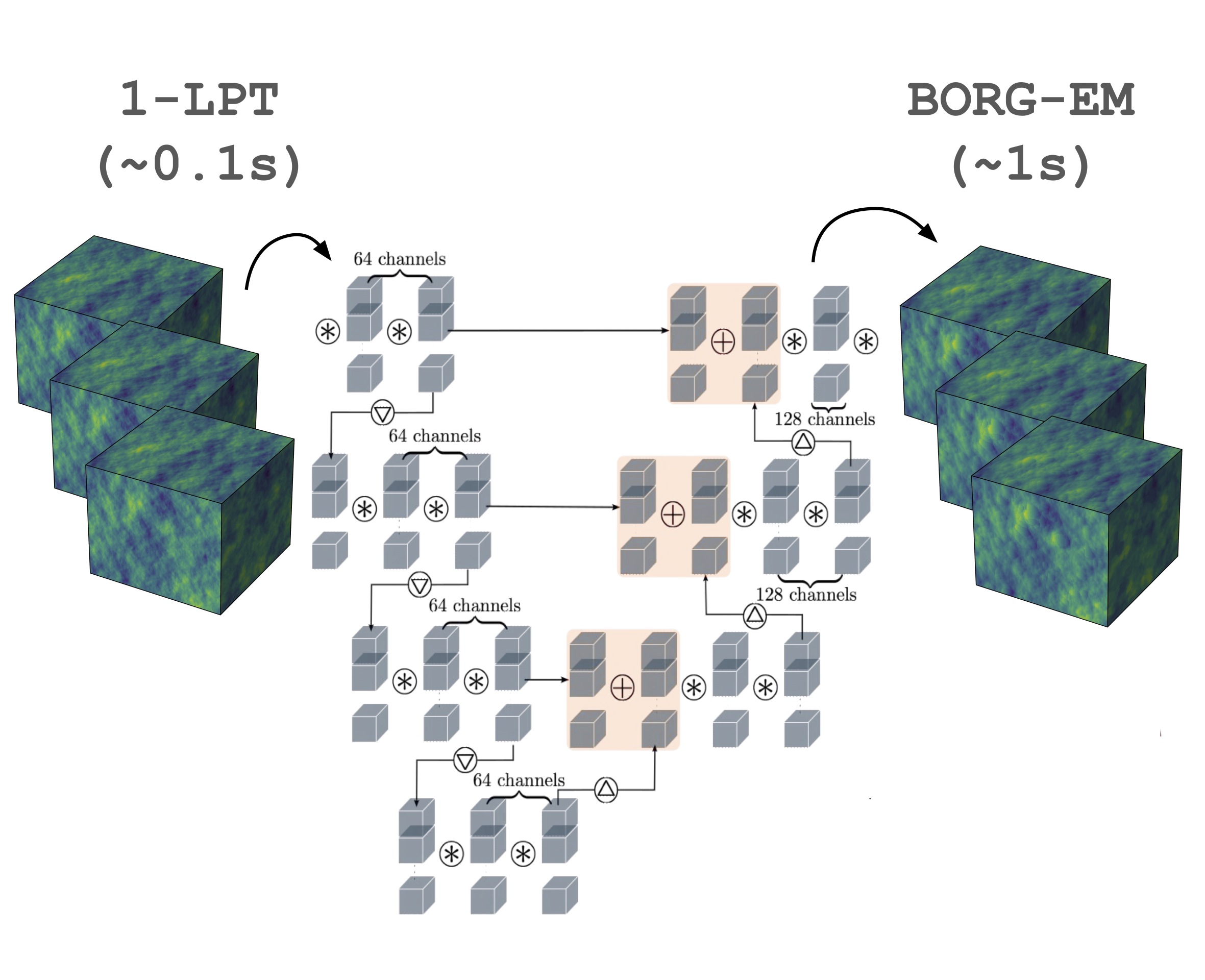
Bayesian Inference of Initial Conditions from Non-Linear Cosmic Structures using Field-Level Emulators
Leveraging a highly accurate physics model essential for next-generation cosmological analysis typically involves significant computational demands. We here propose a solution by integrating a machine learning-based emulator into the BORG algorithm for effective sampling of cosmic initial conditions from non-linear cosmic structures.

COCA - N-body simulations in an emulated frame of reference
N-body simulations are key to cosmology but are computationally expensive. ML can speed them up, but can we trust the results? We propose a new method of combining ML and simulations (COmoving Computer Acceleration - COCA) which can catch mistakes made by ML and correct for them.
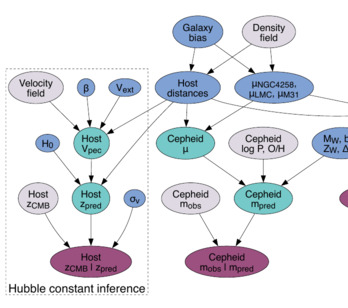
A 1.8% measurement of the Hubble constant from Cepheids alone
The strongest tension within the concordance model of cosmology is a mismatch between the Universe's expansion rate inferred from the cosmic microwave background vs the local distance ladder. We construct a Bayesian hierarchical model to infer this rate locally but without requiring supernovae. We still find a significant "Hubble tension", and achieve unprecedented precision by using BORG velocity fields.