Our mission
We are an international collaboration of researchers interested in developing and applying cutting-edge statistical inference techniques to study the content and properties of our Universe. We embrace the latest innovations in information theory and artificial intelligence to optimally extract physical information from data and use derived results to facilitate new discoveries.Get notified when new results are published @aquilascience.bsky.social
Our latest results
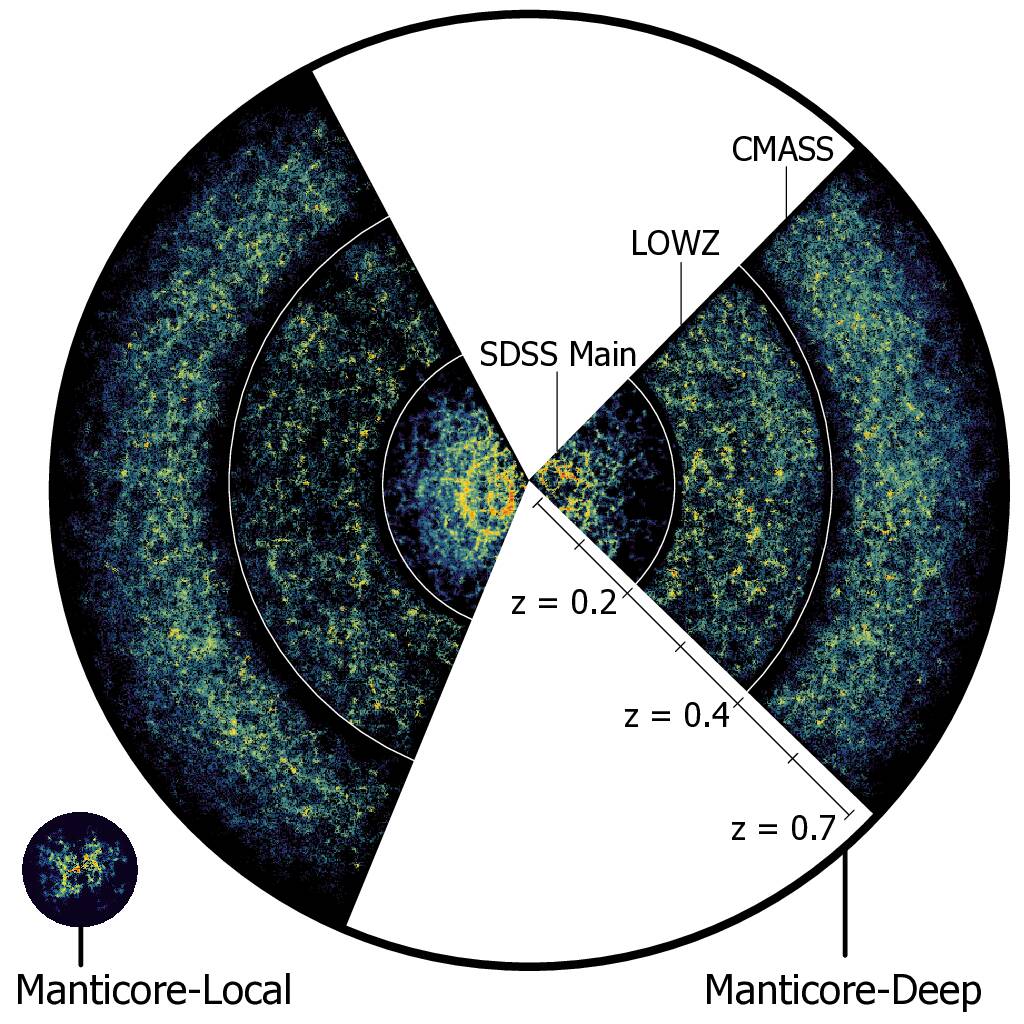
Manticore-Deep: Bayesian Digital Twins of Cosmic Structure Across SDSS and BOSS Volumes
Manticore-Deep is the first high-resolution Bayesian reconstruction of cosmic structure across a (4 h⁻¹Gpc)³ volume out to z≈0.7, jointly constraining 2M++, 6dFGS, 2dFGRS, SDSS, and BOSS.
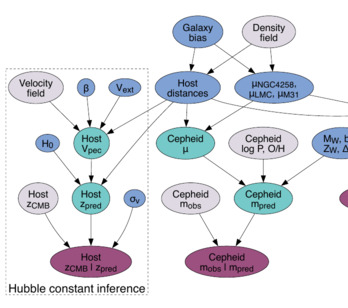
A 1.8% measurement of the Hubble constant from Cepheids alone
The strongest tension within the concordance model of cosmology is a mismatch between the Universe's expansion rate inferred from the cosmic microwave background vs the local distance ladder. We construct a Bayesian hierarchical model to infer this rate locally but without requiring supernovae. We still find a significant "Hubble tension", and achieve unprecedented precision by using BORG velocity fields.
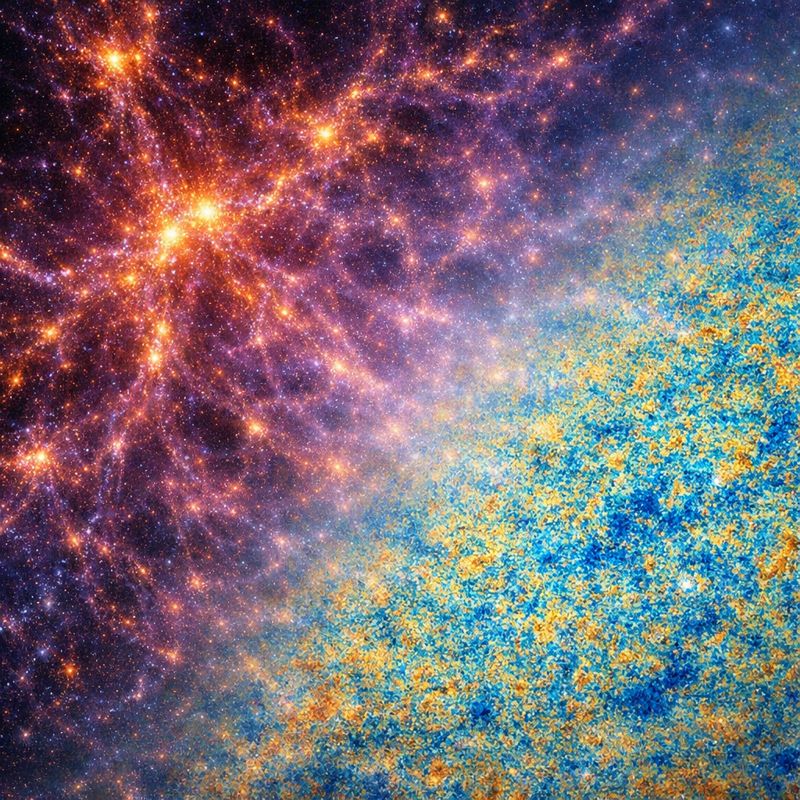
Field-level large-scale structure meets the CMB
BORG is designed for local large-scale structure, but it has significant potential for CMB studies as well. We develop a framework for connecting constrained simulations to the thermal Sunyaez-Zel'dovich effect in the CMB, and use it to show the superiority of BORG relative to other methods and create a new calibration of the cluster mass-observable relation.